

Saturday, 14 May 2011


Friday, 13 May 2011
Mekong River Delta
Frogs (their legs tied together so they can't jump), squirming fish in shallow water-filled bowls (they can and do jump, straight out onto the floor in front of us where they wriggle about pitifully) and pigs' testicles and another nether region (a Vietnamese delicacy). Welcome to one of the many markets that line the banks of the Mekong River.
A canopy-covered speedboat - the heat is a searing 36C - has brought ourselves and nine other travellers from urban Saigon into the rural heartland of one of the greatest waterways on the planet. For the past two hours we have been roaring towards the Mekong Delta, passing hundreds of fishing boats and huge slow-moving barges weighed down by their cargo - mountains of sand.
The source of this mighty river is in the Tibetan foothills and, by the time it empties out into the South China Sea, it will have flowed 4,500km through China, Burma, Laos, Thailand, Cambodia and Vietnam.
Today we will just scratch the surface of the River of Nine Dragons - so named for the way it branches out - but hope to learn something about the way of life here, and bring home a few tales from the riverbank.
We have just stepped off our little boat and entered a world totally foreign to us. As well as those live fish and frogs, there are gaggles of geese everywhere, ducks, hens and chicks - again all alive and kicking, for the time being anyway.
This is not a market designed for tourists - it's too remote. Instead it's where the locals come daily to trade and barter. Here, for example, you can choose a chicken - and the supplier will do the rest, kill it, pluck it and, bob's your uncle, it's a fresh bird on the table for dinner tonight.
A canopy-covered speedboat - the heat is a searing 36C - has brought ourselves and nine other travellers from urban Saigon into the rural heartland of one of the greatest waterways on the planet. For the past two hours we have been roaring towards the Mekong Delta, passing hundreds of fishing boats and huge slow-moving barges weighed down by their cargo - mountains of sand.
The source of this mighty river is in the Tibetan foothills and, by the time it empties out into the South China Sea, it will have flowed 4,500km through China, Burma, Laos, Thailand, Cambodia and Vietnam.
Today we will just scratch the surface of the River of Nine Dragons - so named for the way it branches out - but hope to learn something about the way of life here, and bring home a few tales from the riverbank.
We have just stepped off our little boat and entered a world totally foreign to us. As well as those live fish and frogs, there are gaggles of geese everywhere, ducks, hens and chicks - again all alive and kicking, for the time being anyway.
This is not a market designed for tourists - it's too remote. Instead it's where the locals come daily to trade and barter. Here, for example, you can choose a chicken - and the supplier will do the rest, kill it, pluck it and, bob's your uncle, it's a fresh bird on the table for dinner tonight.
Our guide - a delightful 24-year-old from Saigon with a winning smile and wicked sense of humour - takes us around the market, stopping at various stalls, including the one with the pigs' testicles. (Told you she was wicked).
Not for nothing is this emerald green Delta known as the rice bowl of Vietnam. The place is teeming with sack upon sack of the stuff, sitting alongside different types of dried fish and wonderful fruit and vegetables. We lost count of how many crates of melons, mangoes, bananas and limes we saw. Swansea Market, with all due respect to our dear lady cockle and laverbread sellers, will never quite be the same after this.
Back on the boat we make our way along a maze of narrow little arteries - a waterworld of not only boats, but floating houses and markets. We watch little boys, their skins the colour of teak, leap from bridges into the cooling river, take a swim, clamber aboard the coconut boats that line the river's banks and then race back to the bridge to repeat the feat.
We make our way to My Tho, capital of the Tien Giang Province and gateway to the region. We pull up alongside a fancy-looking riverboat where our group lunch on, among other things, catfish - and very good it was too - washed down by a cold Saigon beer.
Next stop is Coconut Village. A circular walk takes us past banana plantations, pig farms and, not unaturally, row after row of coconut trees. We stop to watch a middle-aged lady weave leaves suitable for roofing. Each strip earns her just 100 dong (less than a few pence). She is hard at work every day from dawn to dusk, but still greets us Westerners with a warm smile.
All too soon it's time to head back towards Saigon, but we will reach there much quicker than those barges - some so heavily burdened by their cargoes that they look as if they can barely keep afloat. It's estimated that a one-way voyage from South Vietnam's major city to the Delta for most of the 14,000 vessels that the Mekong's waters daily takes a month. No wonder given the loads they carry.
Our two-hour return trip still offers plenty of time to reflect on a day well spent in a timeless region where life continues much as it has for centuries. We feel privilged to have gained a little insight into a corner of Asia less travelled than many.
It's a fitting way to say Good Night Vietnam as we contemplate another return to Thailand - this time to Chiang Mai in the north of the country and a sanctuary where wounded and abused elephants are able now to roam freely in a natural habitat thanks to a tiny woman with a massive heart and unbreakable spirit.
Tuesday, 10 May 2011


Monday, 9 May 2011
Ho Chi Minh City (Saigon)
Having spent five lazy days lolling around the lovely resort of Mango Bay on Phu Quoc Island, it's time for a slice of urban reality. Ho Chi Minh City provides it in spadefulls. Formerly Saigon - the most exotic and evocative of names - it's a megawatt bobby-dazzler of a place.
HCMC (it's Saigon for us every time) is, like Hanoi, a metropolis of motorbike madness - two million and counting - but there the similarity ends.
Immediately we sense a more sophisticated city than Vietnam's capital in the north - one that is embracing the modern world and going places. New office buidlings and luxury waterfront apartments are springing up everywhere. It has the same high-octane feel as Bangkok.
There are little alleyways teeming with life, magnificent French colonial-style architecture, ancient pagodas, temples, churches and bustling open-air markets, with stall-holders trading in the same spices and silks their ancestors did a thousand years before them.
Then comes the other side of the coin - towering skyscrapers - one with its own heli-pad - jutting towards the heavens, top fine dining restaurants, five-star hotels, designer shops, an exquisite opera house, museums and malls. Commerce and culture sit side by side and make happy bedfellows.
Where Saigon scores heavily is in its rich history and heritage, nowhere better captured than in its countless art galleries and museums.
Hot and humid it may be - a sticky 36C - but we find the best way to see what it has to offer is by putting our best feet forward and heading out on a walking tour.
We are alarmed to find how little we knew about the Vietnam War and the role Saigon played in it, but visits to a couple of truly impressive museums provide graphic and harrowing history lessons.
The Reunification Palace (formerly Independence or Presidential Palace) is seriously spooky - a bizarre timewarp.
Once a symbol of the South Vietnamese government, it has been left exactly as it was on April 30, 1975, when communist tanks crashed through its outer gates and the Viet-Cong flag was unfurled from the fourth-floor balcony - a dramatic event captured in newspapers and on televisions around the world.
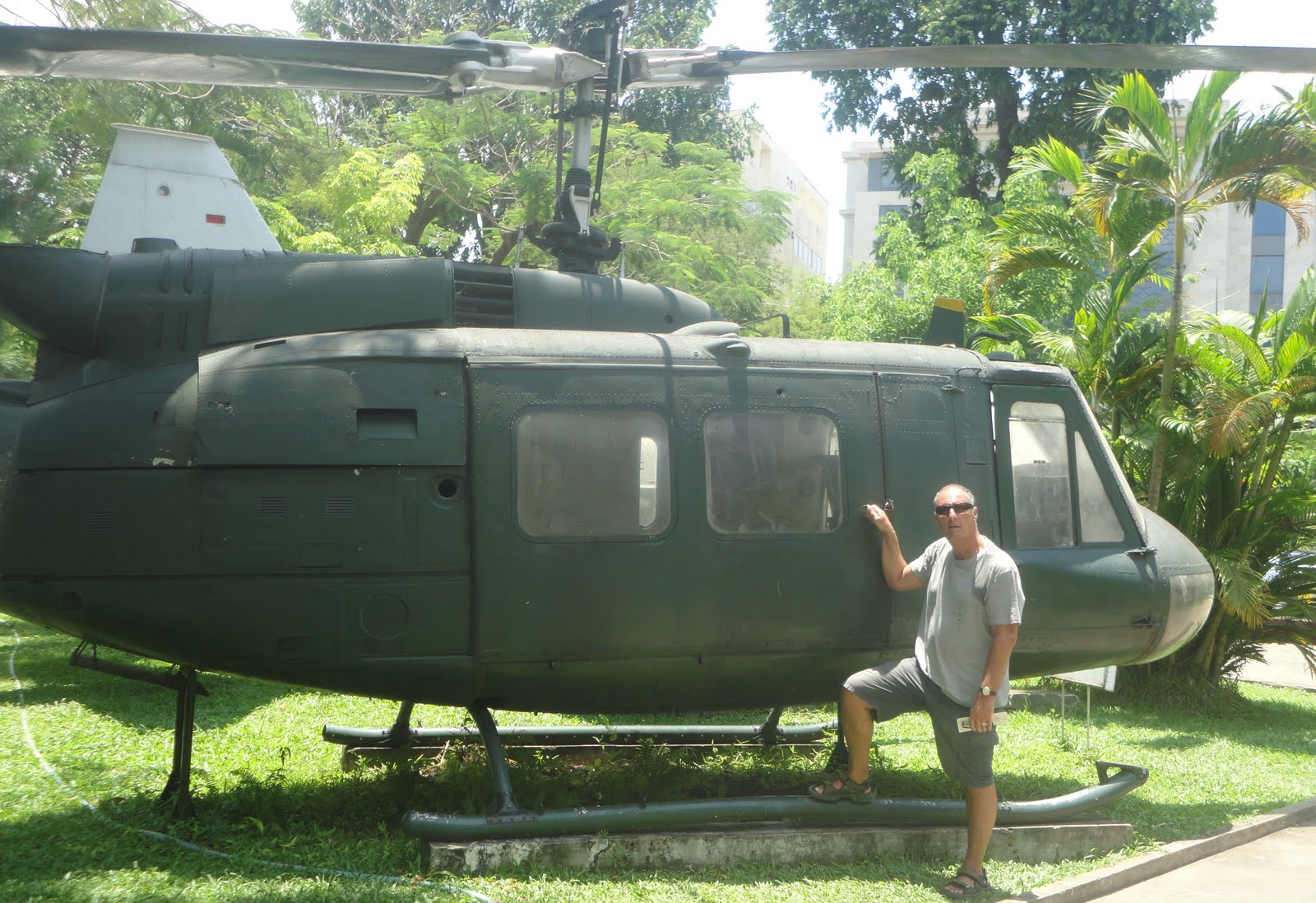
Underneath the building we find ourselves in a warren of concrete tunnels, war rooms and a telecomunications centre, while on the roof a derelict helicopter still sits forlornly. As we walk the building's corridors and peek inside its palatial rooms we feel like we are in a place where time has stood still - and that's exactly what has happened.
The War Remnants Museum isn't bizarre - just gut-wrenching. It took us back to our visit to Cambodia's Killing Fields and the former Tuol Sleng Prison in Phnom Penh - and left us feeling the same way - sad, hollow, and depressed.
It documents in horrifying fashion the atrocities and brutality of the Vietnam War. The mainly black and white photographs of man's inhumanity to man and children affected by US bombing and napalming are shocking enough, but the sight of deformed babies - their defects attributed to the USA's widespread use of chemicals like Agent Orange - are absolutely unbearable.
While it's a one-sided story told from Vietnam's side - we found the propganda both intense and unrelenting - the museum certainly scores by consistenly driving home the message that war is ugly and horrible. Pictures, after all, never lie. We left there knowing what we had seen told the whole appaling truth
Talking of pictures - and on a much happier note - we find some of the best snapshots of Saigon are to be found out on the surrounding streets. Here everyday life rolls seamlessly along - hawkers selling their wares and shouting the odds, pots, pans and saucepans of steaming rice and noodles lining the pavements, little ladies putting electric wires together and motorbike riders, tired of honking their horns, occupying shady street corners stretched out on their machines taking a cat-nap.
Sapped by the heat of the day and after strolling past Notre Dame Cathedral, Saigon's very own version of the grand dame of Paris, we head back to our little hotel in the beating heart of the city for 40 winks of our own.
If Saigon is frenetic during the day, trying to cross the road once the sun has gone down takes on added dimensions. We conquered our fear once in Hanoi. Now we must do it all over again. You have to go for it, or wait kerbside all night for a gap that will never ever appear.
Repeat the formula it is then. Drawing on our experience there, we walk slowly, but purposefully, out into the traffic and pray that we don't get hit. The thousands of scooters, which come from every direction, will ,hopefully, weave around us. We get away with it several times over the next few days - but learn that one unfortunate tourist couple did not, and ended up making a hospital visit.
Nightlife in Saigon, meanwhile, has plenty to offer, with a wide range of street food, bars and restaurants to suit every taste and pocket. One visit to the riverfront proves enough for us. On the Saigon River itself gaudily-lit paddle steamers and floating restaurants try to entice punters on board with special drink and meal offers.
It reeks of tack and tawdriness and is very easy to resist when the street food comes so good and cheap and local family-run restuarants, such as our particular favourite here, The Lemograss, provide such good quality Vietnamese dishes.
Having spent nearly a month in Vietnam our visas are about to expire. We will be Thailand-bound again in a few days time, but no journey to this intriguing land would be complete without a boat trip along the mighty Mekong, one of the world's great rivers.
We want to experience for ourselves what this waterworld, which winds all the way from the foothills of Tibet to the South China Sea, has to offer and, perhaps, meet some of the people for whom the river is the giver of life.
HCMC (it's Saigon for us every time) is, like Hanoi, a metropolis of motorbike madness - two million and counting - but there the similarity ends.
Immediately we sense a more sophisticated city than Vietnam's capital in the north - one that is embracing the modern world and going places. New office buidlings and luxury waterfront apartments are springing up everywhere. It has the same high-octane feel as Bangkok.
There are little alleyways teeming with life, magnificent French colonial-style architecture, ancient pagodas, temples, churches and bustling open-air markets, with stall-holders trading in the same spices and silks their ancestors did a thousand years before them.
Then comes the other side of the coin - towering skyscrapers - one with its own heli-pad - jutting towards the heavens, top fine dining restaurants, five-star hotels, designer shops, an exquisite opera house, museums and malls. Commerce and culture sit side by side and make happy bedfellows.
Where Saigon scores heavily is in its rich history and heritage, nowhere better captured than in its countless art galleries and museums.
Hot and humid it may be - a sticky 36C - but we find the best way to see what it has to offer is by putting our best feet forward and heading out on a walking tour.
We are alarmed to find how little we knew about the Vietnam War and the role Saigon played in it, but visits to a couple of truly impressive museums provide graphic and harrowing history lessons.
The Reunification Palace (formerly Independence or Presidential Palace) is seriously spooky - a bizarre timewarp.
Once a symbol of the South Vietnamese government, it has been left exactly as it was on April 30, 1975, when communist tanks crashed through its outer gates and the Viet-Cong flag was unfurled from the fourth-floor balcony - a dramatic event captured in newspapers and on televisions around the world.
Underneath the building we find ourselves in a warren of concrete tunnels, war rooms and a telecomunications centre, while on the roof a derelict helicopter still sits forlornly. As we walk the building's corridors and peek inside its palatial rooms we feel like we are in a place where time has stood still - and that's exactly what has happened.
The War Remnants Museum isn't bizarre - just gut-wrenching. It took us back to our visit to Cambodia's Killing Fields and the former Tuol Sleng Prison in Phnom Penh - and left us feeling the same way - sad, hollow, and depressed.
It documents in horrifying fashion the atrocities and brutality of the Vietnam War. The mainly black and white photographs of man's inhumanity to man and children affected by US bombing and napalming are shocking enough, but the sight of deformed babies - their defects attributed to the USA's widespread use of chemicals like Agent Orange - are absolutely unbearable.
While it's a one-sided story told from Vietnam's side - we found the propganda both intense and unrelenting - the museum certainly scores by consistenly driving home the message that war is ugly and horrible. Pictures, after all, never lie. We left there knowing what we had seen told the whole appaling truth
Talking of pictures - and on a much happier note - we find some of the best snapshots of Saigon are to be found out on the surrounding streets. Here everyday life rolls seamlessly along - hawkers selling their wares and shouting the odds, pots, pans and saucepans of steaming rice and noodles lining the pavements, little ladies putting electric wires together and motorbike riders, tired of honking their horns, occupying shady street corners stretched out on their machines taking a cat-nap.
Sapped by the heat of the day and after strolling past Notre Dame Cathedral, Saigon's very own version of the grand dame of Paris, we head back to our little hotel in the beating heart of the city for 40 winks of our own.
If Saigon is frenetic during the day, trying to cross the road once the sun has gone down takes on added dimensions. We conquered our fear once in Hanoi. Now we must do it all over again. You have to go for it, or wait kerbside all night for a gap that will never ever appear.
Repeat the formula it is then. Drawing on our experience there, we walk slowly, but purposefully, out into the traffic and pray that we don't get hit. The thousands of scooters, which come from every direction, will ,hopefully, weave around us. We get away with it several times over the next few days - but learn that one unfortunate tourist couple did not, and ended up making a hospital visit.
Nightlife in Saigon, meanwhile, has plenty to offer, with a wide range of street food, bars and restaurants to suit every taste and pocket. One visit to the riverfront proves enough for us. On the Saigon River itself gaudily-lit paddle steamers and floating restaurants try to entice punters on board with special drink and meal offers.
It reeks of tack and tawdriness and is very easy to resist when the street food comes so good and cheap and local family-run restuarants, such as our particular favourite here, The Lemograss, provide such good quality Vietnamese dishes.
Having spent nearly a month in Vietnam our visas are about to expire. We will be Thailand-bound again in a few days time, but no journey to this intriguing land would be complete without a boat trip along the mighty Mekong, one of the world's great rivers.
We want to experience for ourselves what this waterworld, which winds all the way from the foothills of Tibet to the South China Sea, has to offer and, perhaps, meet some of the people for whom the river is the giver of life.
Saturday, 7 May 2011


Subscribe to:
Posts (Atom)